Showing posts with label Social Media. Show all posts

Tuesday, October 1, 2013

Facebook's New Pages To Watch Section


Have you seen this new section in the admin area of your Facebook Page yet?
Facebook has rolled out yet ANOTHER great new feature for Small to Large Businesses and Communities, and this one is going to be a hit!


This allows you to track (or watch) the progress of other pages and compare it with your own page's insights. 

Friday, September 13, 2013

What is a Twitter Party?


There has been a lot of action on social media lately about Twitter Parties. In fact, we're about to have one at my day-job to promote our brand! Yet, every day when the subject comes up I hear the same question over and over again: What is a Twitter Party? How does it work?

Well, take a seat and I'll explain it to you.
"500 Milllll-ionnnnn"

You see, wayyyyy back in 2006 a few enterprising guys thought that all that you needed to get your point across was 140 characters. They weren't exactly wrong (even though it can be annoying sometimes!) and their social networking site, Twitter, has been a big deal ever since.

A big deal to the tune of 500 MILLION followers worldwide and 200 MILLION active users every month.

So naturally, brands and businesses have found a way to capitalize on this ever-growing population of online users. Although many opt for the obvious choices, like promoted tweets and ads, some brands have taken a more organic approach.

Many bloggers and influencers have found great success with twitter, garnering followings upwards of 100-thousand people in a relatively short period of time. Leveraging these bloggers and any bloggers, really, to participate in brand activities and create relevant content that can be shared across social media, is what many brands have done.

Thus came... the Twitter Party!

If you're expecting balloons and pinatas, it's probably not going to happen. But here's what does happen at a twitter party:

1) A brand and a group of dedicated influencers (ex. Bloggers, Notable People) set a date and time where they will all convene to discuss a certain topic. Generally this is directed towards a product or brand launch.

2) A hashtag is selected, usually around the product, brand or topic. This is what creates the conversation that people can follow along with and participate in via Twitter.

3) The Twitter Party is officially launched & promoted. Most Twitter parties involve giveaways and/or prizes to participants to incentivize people to engage with the brand. Attendees are generally asked to RSVP ahead of time so they can be cross-referenced to win prizes.

4) The day of the twitter party arrives. If the party is successful then generally the twitter hashtag will become a trending topic. (Many tweets with a specific hashtag from a wide range of users in a short amount of time = trending topic)

5) Most Twitter Parties involve a Question & Answer format where the host(s) will ask questions in a Q1 / A1 format. As the questions are put out, attendees are asked to respond (including corresponding A# and hashtag for the party) and then winners are selected. Most are selected randomly and aren't reflective of the quality of the tweet.

6) Most parties generally last about 1 hour and have between 4 and 10 questions and/or prizes. Generally they will start with the smallest prize and work their way up to a Grand Prize. Some questions involve trivia and links to brand-specific landing pages where hints are available. Many questions are more subjective and are opinion-based. Usually there is a combination of both for a wide variety of responses.

Here's what you should know before you consider attending a Twitter Party: 

A) It's going to be brand-heavy. Be positive about the brand.

B) Yes you can win free stuff, but it's also about networking and creating a meaningful conversation.

C) If you don't win free stuff, that's okay. Hundred's of people attend twitter parties and only a handful win prizes. There's always a next time.


Here's what you should know before you consider throwing a Twitter Party: 

A) Although it's brand and product specific, Twitter Parties aren't created as a means to sell product. Most participants are in it for the free stuff and are NOT going to make a purchase based on activities around the product. As a brand or business your focus should be on building relationships and long-term brand visibility.

B) The best Twitter Parties are the ones that really inspire people to engage. (i.e. Asking generic/boring questions isn't entertaining and likely won't be that impactful.)

C) Your influencers = Your reach. Don't be afraid to pay for high-quality influencers, because they will make the difference in the overall success of your party.


Anyways... that's Twitter Parties in a nutshell. Got a question? Leave it in the comments below!


Tuesday, September 10, 2013

If You Don't, Someone Else Will

I was thinking today about what makes a social network so successful, like the Facebook's and Twitter's out there. There are only a handful of really useful, substantial networks out there. The ones that I discuss in my presentations and workshops. The ones that a brand "can't exist online without."


As a social media specialist, content creator and aggregator... as a person who measures collective interest in these sites and their product for a living, it's easy to see what makes each site individually appealing. How one site is used versus the other, and how each creates its own style of meaningful connection and ability to interact with other people -- customers, friends, companies; you name it. 

But how do you know when you've really got something special on your hand after you come up with an idea for a new network in your dorm room? Is it your first fifty-thousand early adopters? Your first million? Is it when the news begins reporting your impact? When companies can't "exist" without being part of your network? 

Nope. All close, but not close enough.

The real testament to a social network's rank? When other social networks use your network as a means to provide information to their users, developers and fans. 


After this moment of clarity (accurately depicted here in a tweet) I went searching. Here's what I found:

Pinterest on Twitter - 1.48 M Followers


Google on Twitter - 6.89 M Followers


A "Google on Twitter" list containing all of the offical google
twitter accounts -- on Twitter, by Google.
173 Official Accounts.


Some of the List Members of Offical Google Accounts of Google on Twitter, by Google... on Twitter.


A Twitter Page on Facebook. - 10 M Followers

A (slightly underloved) Google Plus page on Facebook. 


An Official (and verified!) Google page on Facebook.
14 Million likes.


Official Pinterest page on Facebook. 2.8 M likes.


An Official Twitter Account on Pinterest.
Not very many followers. 


It's actually quite humorous if you think of the moment a social network social media marketing team has to decide to officially launch a page on a new social network.

But, in reality... it shouldn't be that funny. Any business should be concerned with staking a claim in what is, for all intents and purposes, theirs. Right now it probably doesn't seem like a big deal to a small business if they have to secure their pages name on Facebook, make sure they're on top of their Google Plus page so they can tie in reviews, or launch a twitter page to connect with local users. In a little while, when they are finally at that step and need to confirm their pages they may have become popular and someone else has reserved those pages.

It has happened to me before. In a large corporate setting, I was the new social media marketing specialist and it was my job to put them on the map, so to speak. Well lo and behold a multi-million dollar company's name isn't available anymore. Of course not! Someone thought to take it for themselves, whether intentionally or not. 

The process in trying to attain any previously registered name for your business can be time consuming and often doesn't even yield results. Often times businesses just have to choose another name altogether, if they didn't agree to pay through the nose for the one they wanted originally.

My advice to you (and to emerging social networks out there!) is to stake a claim in whatever you can... now. When they're still a good chance what you want is available for the claiming. Develop your brand with these things in mind.

My other advice? You really don't need 173 different pages that all essentially do the same thing. Er... unless you're Google. ;)

Wednesday, July 31, 2013

What are your Fans worth to YOU?


As a brand and social media specialist, it is expected of me in some sense that when I like or support a brand I will share their posts, product and ideas across social media. When I see something that piques my interest it either ends up here on my blog, or elsewhere on Twitter and Facebook. I try to reward and encourage brand accounts, especially those belonging to small businesses to keep their momentum building in their social space.

But there are other people out there, not like me, who don't actively look for opportunities to share and engage with brands. A lot of business owners who've yet to embrace the social sphere write the idea off entirely because they feel that a fan liking their page on Facebook or re-tweeting a post on their Twitter feed has no bearing on sales. Well I'm sorry, business owner, but you're WRONG. You're so so so wrong.

On Facebook alone, the basic act of a fan "liking" your business page is valued at $174.17.


Friday, July 26, 2013

My Facebook Page Reach Has Declined! Guess What? It Doesn't Matter!


So your Facebook Page's reach has dropped... not as many of your fans (and even less non-fans) are seeing your posts! It’s not the end of the world, I promise!

Lately I have seen many Facebook Page owners (mostly bloggers and small businesses) complaining or posting about the decline in the reach of their posts. Although this may have an initial significant impact in your growth, it doesn't impact the way your fans interact with your page.

Here are five things you can try, or remember, when it comes to your Facebook Page:

Monday, June 3, 2013

Pinterest: Increasing Your Web Traffic Using Photo Sharing


I was an early adopter when Pinterest came out. It was like a bad addiction, except good. I loved it! I couldn't get enough. Although my time spent on the site has wained over time, I've still got the same love for Pinterest as I did in the beginning. 

There's two main reasons for that. 1) It's always been very easy to use and 2) it's visually appealing!

Saturday, June 1, 2013

What is Klout and how does it work?

What is Klout | How Does Klout Work | The Social Mom | thesocialmom.net


You may have been perusing Twitter and noticed that people are acknowledging something called their "Klout Score" and thought to yourself, what is this exactly? Or maybe you're a business and you're considering putting a perk online to get the word out about your services. Either way, if you're wondering about Klout, you've come to the right place!

Klout is an online start up that takes all of your social media activity and determines your online influence based on how many people follow you, friend you or fan you, and how well your posts do based on those numbers. The algorithm is a bit more complicated than that, but suffice it to say that your Klout Score is a number that indicates what your overall influence is online. The more you create impressions and engage, the higher your Klout Score.

Tuesday, May 21, 2013

Teaching Your Kids How to Use Social Media


It's safe to say that when it comes to kids, Monkey See Monkey Do is a realistic approach to parenting. We try hard to limit them seeing our "bad behaviours" because we know they will most certainly mimic them. When it comes to Social Media it's hard to determine as a parent when is an appropriate time to start phasing your kids into using it.

I hear many parents talking about limiting their kids' screen time, or not allowing them to use computers or technology at all, because they're worried about the toll it takes on their development. My approach, as a parent and as a social media strategist, is slightly different. Although I do limit my kids' screen time, I don't think that restricting their access to the technologies is the best approach. In fact, I think that could have a negative impact on their capacity to learn alongside new technologies later in life.

Wednesday, May 8, 2013

When Social Media Attacks: How to Calm The Storm

source
Although there are 1,000,001 GREAT reasons to use social media to your full advantage as a small or large business or brand, one of the things you HAVE to have on your radar and plan for is a viral attack.

In social media, especially as brands we are largely dealing with customers... most of whom are happy to provide stellar feedback and recommend you when people are looking for suggestions. THIS is why social media is such a massive aspect of marketing today and a must-do when it comes to launching word of mouth campaigns.

There is a flip side, though. A dark, scary place where one unsatisfied customer, however legitimate or radical their concerns may be, can negate all of the work you've done to grow a following.

In the "days of yore" it took contacting media outlets, constant negative spin or a terrible tragedy to send a businesses' marketing efforts into a tail spin. These days, one unhappy customer with the right "friends" or "followers" can turn your whole business upside down.

Tuesday, May 7, 2013

Leading The Pack: Responding to the Consumers Needs in Web and Social

Although mobile integration has long since been an important aspect of all things social, only recently has it become so painfully obvious how without mobile, the social media we know today wouldn't exist. We are constantly on the go, managing multiple tasks at once and with the advances in mobile technology creating a seamless blend of work life and social life has never been so easy.

The use of social media is consistently growing and changing, but what is also changing is how we use social media as consumers and as brands. As you can see in the infographic below, Facebook's mobile usage has climbed significantly in the past year, with 68% of its users now using Facebook on Mobile Only or in a combination of Mobile and Desktop.


As brands we have to be aware of these ever-changing behaviors, filling the gaps with little to no downtime. Being aware of how your target audience consumes your content allows you to effectively market to them.

This is as simple as creating a responsive website that has code that can be manipulated depending on the size in which the site is being explored, allowing the same look and feel across a variety of devices and platforms.

The other day I saw a contest run by a local organization float through my news feed, their call to action was "visit our website and enter" and being on my desktop I simply entered the URL into my browser. Once the website loaded it was plain to see that the website was built for "mobile" use. I actually went so far as to go back to the facebook page it was posted on and say "this website is not desktop-friendly!" which is a rare occurrence for me.

In most instances the opposite situation generally happens, we click on a link on our mobile app/browsers and it takes us to a wide format, bulky website that is text heavy and far too small to read when live on our smart phones. With a bit of pinching and tilting you might be able to get it to work, but generally in our current "technologically consumptive society" we're more interested in having things just work right the first time. Hence, responsive web technology.

Obviously this goes both ways. We want the same site to work as effortlessly on a mobile phone as on our google chrome browser. By not having a desktop-friendly website, that organization has lost countless lead-gen opportunities due to probably significantly higher bounce rates than normal. Why? Because they're not catering to an audience, however mobile-friendly they might be, who are at work, at home, at a hotel conference, using a PC instead of their smart phone. When something isn't appealing generally people aren't going to stick around long enough to figure out how it works these days.

So my advice? Be on the leading edge. Adopt responsive technology on your website, so no matter HOW someone gets there, they're more likely to stay there.

Tuesday, April 9, 2013

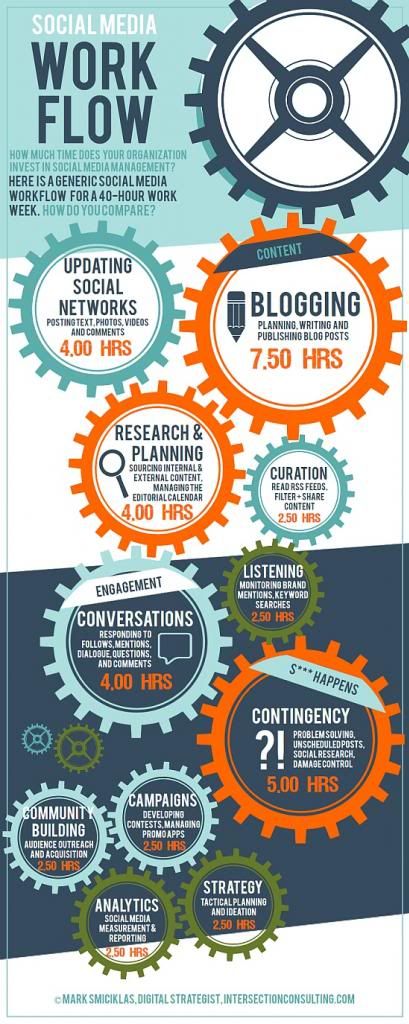
How should your organization's Social Workflow be spread out?

Organizations finally embracing Social should by now understand the impact of social media, but how much time should your community or digital marketing managers be allotting to each area of social?
Here's a great infographic that breaks it down!


Wednesday, February 6, 2013

Contests and Giveaways

Did you know that running native contests on your Facebook page is against their Page Terms & Conditions? Every single day I come across pages running "Like this!" and "Share that" contests, within their posts. This type of contest is against Facebook Policies and could potentially have your page shut down. The way Facebook wants people to run contests is through developer apps like Rafflecopter, Offerpop or Shortstack, to name  a few. Basically, what that means is instead of using "organic" facebook actions like "Liking", "Sharing" and "Commenting" on pictures/posts, you are taken to a built-in tab on the page where fans and entrants can do the exact same actions, but without breaking the rules.

The additional benefits of this type of app is that you can "Fan Gate" it, which means that before someone enters your contest, they're required to like your page to see the entry form or rules. This can significantly jump your page numbers if the incentive is good enough.

Here's some more information on how to create contests and giveaways via Facebook:

One of the fastest (and best!) ways to increase your Facebook traffic and "likes" is to utilize a built-in contest app. There are the "build it yourself" kinds like Rafflecopter (which now integrates directly with facebook pages!) and then there are the "pre-built" kinds like the campaigns offered by Offerpop.


Did you know that Offerpop gives you the first campaign you run for free?!

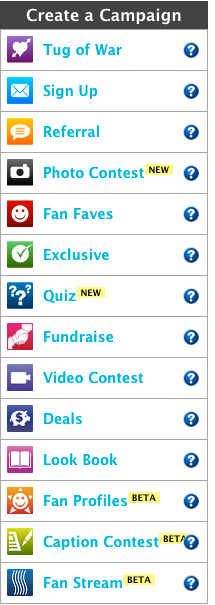
It's a great way to try a new format for contests and try your hand at the program, too. Quite easy to use, their system allows you to pick from a wide variety of campaign "types" including Photo Contests, Referral Programs and more!

Each campaign is pre-built (it even gives you examples and dimensions for the graphics needed to run the campaign!) and you can easily select which page you want to run it on with a drop down menu.

If you're like me and support multiple pages every week it's a great option for running multiple campaigns simultaneously.

And the best part? Offerpop has already worked out all of the kinks, working within the Facebook Rules and Regulations and creating coherent campaigns that give real-time analytics.

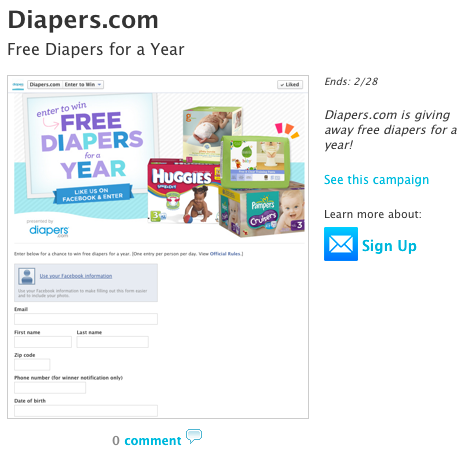
An example of one of their great campaigns is the "Diapers.com" campaign. Allowing anyone who signs up to enter to win Free Diapers for a Year, this contest drives participants to the facebook page and is a simple "Sign Up" style campaign. Easy for the user to enter and can return a lot of results.


Who wouldn't want the chance to win FREE diapers for a year?

One of my go-to apps for running contests (especially on blogs and websites) is the Rafflecopter widget. This allows you to create a variety of different qualifying ways to enter a contest, the whole thing is pre-coded but allows you to customize the app depending on the contest that you're running. 

I am currently running a contest on my lifestyle blog Crawl The Line for the month of February called 7 Days of Giveaways! For each day the contest is running (7) there is one prize (a piece or set of jewellery) to be drawn at the end of the week. This allows me to cross-market with a sponsor, create a widget that's built directly into my blog (no going elsewhere to sign up for the contest!) and integrates across a variety of different platforms (Pinterest, Facebook, Twitter and Blogger -- plus many more!) their basic (unpaid) version of the app is totally useable as many times as you want, and if you want even more great options (like real-time analytics) you can subscribe to their service for a small (or large, depending on how much you need to see) monthly fee.

This totally isn't a sell for Offerpop or Rafflecopter, but I do have to say they are both great options for any campaign you want to run in the social sphere!


Tuesday, December 4, 2012

Case Study: Content Marketing


A lot of brands understand the importance of social media, but explaining what the difference between posting an advertisement and content marketing is can be a bit complicated to say the least.

As a brand, you have a target demographic. This target demographic, if targeted correctly, can become your audience. As an audience they don't want to see commercials (most people fast forward through those these days, don't they?) -- they want to see real, fresh and relevant(!) content.

There's no easy equation to what your ideal content is. Depending on your audience it may be facts, funny photos, interesting or new products, found objects or even the weather.

Here's a great example "case study":


Coffee & Cakes is a quaint coffee shop in a growing, but small town outside of a major city. They recently opened up in the small town, offering a comfortable environment filled with fresh brewed coffee, sandwiches and, yes, cakes.

Even before opening their doors Coffee & Cakes had adopted Facebook as their main social platform. They created a facebook page where they could build an audience (targeted locally, of course) and grow awareness about their store. Every morning owner Mark Robinson posts what's on their menu, what the weather is like and occasionally an interesting factoid.


People in the community have come to appreciate this morning greeting and often stop into the store because of the wake up call being in their Facebook feed each day. A simple reminder of "hey, we're here!" doesn't have to be so in your face. This type of content sets a tone that says, "we're here ready to serve you whenever you feel like dropping by!" and they meet that with excellent customer service.

Mark responds to every comment and post on his Facebook page personally and has really given a soul to their brand.

This is such a great example of small business utilizing social media as the foundation for their marketing, and creating fresh content on a daily basis that is engaging to their community.

Monday, December 3, 2012

Loft Resumes

When you work in social media or design, being visual should be one of your top priorities. So, when looking for a job it's important to make sure your resume looks as good as it reads! Here's an example of a loft resume made by yours truly.

Monday, November 19, 2012

When is the best time to use Social Media?


So you've got the Facebook Page and the Twitter Account, but you are still having trouble managing your Social Media? We've covered the Why you should use it, and the How you should use it, but what about the When? Is there an optimal time to be utilizing your social media? 


Most social media sites seem like they never slow down. It's true that because they're global sites and people around the world use them consistently throughout a 24-hour day it would seem that there's no wrong time, but depending on your target market there might just be one for you. If you're a local business aiming at individuals who operate on roughly the same schedule as you, then tweeting Monday to Friday after work hours will most likely be ideal. 

But did you know that weekdays actually aren't the ideal time to tweet? That's right, because Twitter and Facebook marketing engagements increase over 17% on weekends! That means that there is a whole group of people who are trying to keep their day-to-day lives social-media-free. 

Many offices don't allow access to social media sites or use of private phones during work hours. Others are bound by strict technology rules and are only allowed to utilize social media for work-related purposes. Furthermore, many people find social media altogether too time consuming or regular use makes it too difficult for them to focus on their task at hand. 

8AM - 7PM Sunday through Saturday sees a 30% increase in engagement vs. outside hours. So although there are many people tuning themselves out during work hours, throughout the week there is still an opportunity to engage, it should just be within standard operating hours. 

Also, Did you know that shorter tweets and content on facebook often see higher engagement? Even YouTube videos all have a click-off rate based on when people stop watching. If you don't catch people's attention within the first 100 ch. or 30 secs you're not likely to at all. 

So what do we know then? 
  • Tweeting / Facebooking on Weekends is ideal to Weekdays
  • Overall the best hours to Tweet/FB are 8AM - 7PM daily
  • Using 1 or 2 #hashtags in your tweet increases your overall engagement by 12
  • Using MORE than 2 #hashtags DECREASES your engagement #overkill


The key to accurate and efficient content marketing in social media is first knowing how to do it, but secondarily knowing when to action it! Good luck!


Friday, November 16, 2012

Make Time for Social Media


I was at a tradeshow this past weekend and was running a pretty cool and effective social media contest! 

The concept was simple: Follow my company's social media page, tweet about it and I would tweet you back to come pick up your prize: A $10 Starbucks card! 

(source)
Very big engagement for very little work and spend (overall!)

Although there were many people hopping on the bandwagon from tweets and posters scattered around the conference, I made sure to tell everyone who stopped by about the contest. In the days where tradeshows and conferences have become a huge swag-grab for so many, having a real engagement can be difficult. Most attendees are there to trick-or-treat and that's about it. They don't want to hear about your offering and they certainly aren't going to stand around and chat about it with you. So, the issue becomes not about impressions, we make plenty of those, but about engagements!

By enticing the attendees to follow us on Twitter or like the Facebook page, what it actually does is give them an opportunity to learn about our company, not on the tradeshow floor, but later, in their news feeds. It also provides us with insight into what they're thinking about and the ability to engage with them later.

Conferences can be an excellent example of where to find your target market. Most of the people who attend them already have ties in the industry you're aiming for, and if they aren't currently in a decision making role, they could be in just a few years. So, by utilizing a contest campaign wherein they have to follow your page or feeds, it allows you into their psyche every now and again. Regular impressions, and hopefully, down the line, more engagement.

Now one thing I heard a lot throughout the day was "Oh I don't use twitter." or "I deleted my facebook account!" and although I'm sure a few of them just had that "don't advertise to me" barrier up, I don't doubt that it was true in many cases. Unfortunately they're missing out on the big picture and we're missing out on their engagement!

But it did make me think, even our own CTO (Chief Technology Officer's) keynote was based on the huge influx of social media use in today's market and how that impacts the IaaS and IT-Managers running businesses. But even he, the guy GIVING the keynote, isn't an active social media user. He acknowledged it's importance in the marketplace, but can't find time in his schedule to actually engage.

It is my full time job to be dedicated to engaging on my company's behalf, which is fine and dandy, but at the end of the day if our company had more names and faces living in social media, chatting about our offerings, it would make us that much more effective overall. It's definitely something I'm working on, getting others to engage around our branding and just technology in general.

So many small business owners and large enterprise executives have a difficult time making time for social media. And it's a shame, because that's where we can truly engage with others. Not advertise to them, but talk to them. Get into their heads and learn not only what we're doing right, but what we could be doing better and what we should be doing next year. Keeping up with the fast pace at which technology grows isn't easy, so why not tap into a market where others are keeping up on it for you? Cultivate lists and followers who can tell you what you need to know!

After all, social media isn't just about advertising, in fact, it's rarely about advertising. The true experience of social media lives at the engagement level and it's an opportunity for us to learn more about our businesses and our demographics without ever having to leave our offices or apartments or cars. Using it as a true empowerment and engaging with those who can offer some true insight into our growth potential is only one of it's major benefits, but it's certainly not one to be overlooked!

So here's your homework: Dedicate at least an hour EVERY DAY to just engaging on social media. It will take days, weeks, probably even months, to get it right. But once you've learned to commit yourself to the engagement so much information and insights will be flowing to you it will be impossible to deny it's effectiveness!

Schedule it in your calendar, around your existing work day. Employ your coworkers to do the same. If you want to increase your brand awareness online the key is to increase your activity first!


Thursday, November 15, 2012

Facebook: Groups vs. Pages vs. Accounts

Everyone (okay, okay... Almost everyone....) uses Facebook! Over 850 MILLION accounts are used monthly and we do it for everything... did you know that these days many people will put their search terms into FACEBOOK search before even heading over to Google?

So there's no question that we all use it but that doesn't mean we all know HOW.

In so many instances I've been hired on to manage a Brand's facebook content and realized that they've been operating their brand visibility through a Facebook ACCOUNT!

That's basically like going to the bank to rent your movies! Okay, maybe not that bad, but I mean, c'mon!


So, let me explain the difference, the very BASIC difference between a Facebook Account, Page and Group.


1. Facebook Account
This is owned by a user. This account has a profile page, can write notes, can see people's feeds that they are friends with and can engage on basically every level. You can like pages, connect with your mobile devices and even connect it with other social media streams (twitter, foursquare, instagram etc.)

These accounts can have very low to very high privacy settings to help determine how much or how little access you want the outside world to have.

What is this meant for? This is your online existence, your profile..  this is meant for People.


2. Facebook Page
A Facebook page is created by a user, usually to represent a brand, person or community of some kind. People access this page by "liking" it and for most intents and purposes you would want it to be open and available to anyone who uses Facebook.

Just like on your Account Profile, you have a profile page that anybody can see. It has your "about" information as well as a timeline where you can post Status Updates, Photos, Events and Milestones. The difference is that you can have more than one person "manage" or "create content" for this page and you don't "friend" people like with your account. In order to get someone to follow you page and it's engagements they must first "like" it.

Once again it can be cross-marketed with other forms of social media like Blogs, Twitter, Instagram and much more!

Pages can create events and promote other pages, as well as being sub-pages to other affiliated pages like organizations or communities.

What is this meant for?  A FB Page is meant for Sharing and Liking. It's meant to engage with fans and followers on a regular basis but is seperate from an account in the sense that it's more for the output of information than cross-information. This is ideal for Companies, Small Businesses, Artists, Brands, Figureheads, Musicians/Bands, Fictional Characters, Blogs and more! (Basically anything that isn't a [famous] human being.


3. Facebook Group
Just like any other group, a Facebook Group is a community. Within that community there are people (with Facebook Accounts) that can share information. Any managers of Facebook Pages can also share information to a group via the sharing button! -- The difference is like an account you can control overall visibility across the facebook platform, but like a Page, you can share and people can choose whether to or not to like it.

Groups can make events just like accounts and pages, however once again there are privacy options that let group administrators manage who can see/join/attend said events.

Groups are there to generally post about certain subjects related to the group activities or culture.

What is this meant for? A FB Group is there to allow people who are part of a community (whether public, closed or private) to communicate in one open forum. This would be ideal for members of a team, organizations, people looking to meet other like-minded people or businesses working in similar industries.


Got it? Good! 

I hope you enjoyed this brief introduction into the Rules of Facebook! Do you have a facebook account, page and/or group? Do you use them effectively?

Tuesday, November 13, 2012

Social Media Cheat Sheet

I wish I could say I put this together, I've really got to get on this #infographic bandwagon already!
Here's an easy cheat sheet for SoMe (that's Social Media in cheat-speak!) n00bs (that's newbie in lame speak!)

source: fusedlogic


Monday, November 12, 2012

Social Forum: Q&A Mondays


You've found yourself at my newest feature! Social Forum is a way for followers and businesses to ask questions related to Social Media and Social Media Marketing... each week I will feature a few questions (and my answers) regarding things like Facebook Pages, Increasing Likes & Brand Visibility! Hopefully you can learn something, too!

Want to ask a question? Post one here on my Facebook Page or Tweet me at @christellasays with hashtag #thesocialmom and you might just find your answer here!

Our first question comes from Jen P. over at Finding Momtopia ...

Jen asks: "Where to draw the line on how often to post on our FB business page? What's too little and what's going to cause our followers to hit the remove button?"

That's a great question! Just like anything the idea of "too much of a good thing is a bad thing" is totally relevant when it comes to social media and marketing, especially for business purposes! Creating brand visibility and consistent engagement is vital to a new or growing brand, however over-using your social feeds can deter people who had previously liked your page from engaging with you in the future.

Avoid "Spamming" When creating post content it's important to steer clear of solely "advertising" to people. One of the reasons people like social media is because they don't feel like it's a complete money grab. Most services are free and although brands do use many of them to highlight products that are for sale, they do it in a way that says "If you like this come and get it" and not "Come buy this now!" -- As I always say it's better to initiate conversations around your products than to just straight up advertise them. Also, to break things up ask questions, generate ideas and share other people's ideas, products and giveaways, too!

In terms of "how much is too much?" it can be a bit relative, but posting every hour or every couple of hours if you don't have a large audience to engage with is probably overkill. There's no rule of thumb, but I like to let my posts linger, give the followers a chance to see them and engage with them before moving onto something else. I'd say if you're not generating a lot of response keep your posts limited to two per day and try to find your "voice" that gets people engaging!

If you've got a lot to say, use the "scheduling" option and post in the future so that you have less to do in the long run!

----

Diane D. from  Little Prints Design   asks: "Question on blogging ... should you stick to a particular topic or is it okay to have random topics that don't always go together?"

This is a great question, Diane! It really depends on what your blog is about. If you're writing a lifestyle blog or it's considered "personal" then by all means, it's sort of a free-range type of writing. You have to know your audience and know how they'll take your blog posts, but if you're just starting out the best way to improve your writing is to challenge yourself by writing in many different ways and styles. It's also a great way to see what clicks and when.

If you're writing a blog pertaining to a business or a brand, sometimes steering too far off course may be a bad idea. In most cases companies want to be aware of what their brand entails and not stepping on anybody's toes but  that being said, occasionally writing about something that ties into your brand or blog's personality can work. An example of this would be a Design company who has a blog writing about an interesting concept in design or a new product in the market. It may not pertain directly to what your brand or blog is about, but if you can tie it in, no harm no foul!


Have a question about Social Media or Web Marketing? Tweet it to @christellasays with hashtag #socialmom OR visit my Facebook Page at http://facebook.com/thesocialmom to ask now and you might be featured in next week's column!


Tuesday, November 6, 2012

Why My Kids Have Facebook Pages


(source)
We've all seen those viral messages about such and such a group that is sharing pictures of peoples kids to pervs online. We all know someone who refuses to get facebook or let their kids ten feet close to a computer for fear that their information will be saved and used against them for identity theft or other unmentionable things. And you know what? I get it. I really do. 


Given my day-to-day job the instinct I've developed over time is share. share. share! But at what point is it too much? Letting your kids open up their own facebook profiles? Getting them their own computers from which they themselves can do what they please on social media? Making a facebook page for your unborn baby?


Most people I know don't let their kids open their own Facebook Pages or Twitter Accounts until they're past the sign up age limit (14) for the networks. That seems fair. After all, they should be old enough and responsible enough to understand how to use the sites properly.

So then why did I create Personal Facebook Profiles for each of my kids? I mean they're not even close to the legal sign up age, right? (Big is 2.5 and Little is almost a year!) -- Am I crazy?